



Educational model
The Becoming Education model
We believe that every child thrives best when they have meaningful experiences, genuine relationships and an environment that nurtures their natural curiosity.
It is precisely this curiosity that we turn into the drive to learn.
Our educational model is based on solid pedagogical principles, backed up by neuroscience: we learn best through hands-on experience, by experiencing positive emotions, and by sharing the journey with our classmates.
That is why we have created an environment where emotions and learning go hand in hand.
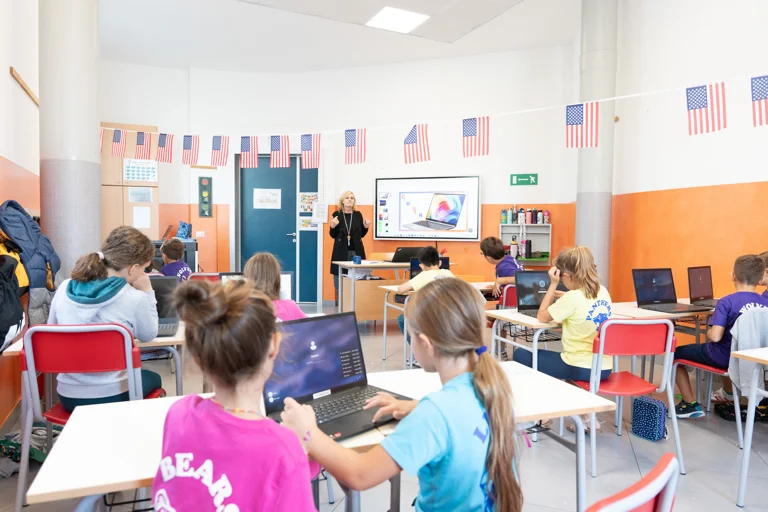
Our programme is bilingual in Italian and English and embraces multilingualism with the study of German, supporting students’ growth through continuity between Primary and Middle School. We combine the Inquiry-Based Learning approach and active teaching methods with the National Curriculum Guidelines, following a spiral model: concepts are revisited over time and explored in greater depth to transform into practical skills.
Studying is not an end in itself, but aims to build a solid foundation on which to grow.
At OIS, children and young people grow up in a welcoming and stimulating environment. The spaces encourage social interaction and make every child feel like a key player. OIS teachers work as a close-knit team, co-designing interdisciplinary pathways that adapt to the needs of the group.
Families are our allies. We believe that schools and parents should work together, sharing experiences and educational goals.
The foundations
The vision and principles that guide every decision we make
At the heart of our approach
We turn children’s natural curiosity into a drive to learn. Meaningful experiences, meaningful relationships and an environment that nurtures each child’s individuality: that is how we truly grow.
A bilingual school with an international focus
OIS is a bilingual Italian school with a strong international focus. The curriculum ensures that the objectives set out in the Ministerial Guidelines are met through active teaching methods.
Multilingual Curriculum
Italian and English are taught side by side every day, as part of a structured programme that takes pupils from Primary School through to Middle School, culminating in recognised international qualifications. The programme is further enriched by German, which is introduced as early as Primary School and leads to Goethe-Institut qualifications in Middle School.
How we learn every day
Active approaches that put children at the centre
Learning together
Peer Education and Cooperative Learning: learning together is more effective. Small-group work, peer tutoring, collaboration.
Sometimes a concept is easier to understand when a classmate explains it.
Interdisciplinary design
Interdisciplinary design is at the heart of the OIS programme. It broadens students’ horizons and keeps them engaged. Their knowledge grows over time, deepens and develops into practical skills.
Active and inquiry-based learning
We don’t just listen: we do, we try, we build. We start with curiosity, not with answers. Questions → Research → Verification → Synthesis.
The children take centre stage and develop their own way of learning.
Teachers make all the difference
A close-knit team, united by a shared vision. They design the programme themselves, with passion and expertise.
Thanks to the Becoming Academy, teachers keep up to date with innovative teaching methods, emotional intelligence and inclusion.
Growing as people
Not just facts: life skills
Emotional and social skills (SEL)
Emotional and social development is an integral part of the educational programme at OIS.
Through cooperative learning, drama, group work and daily dialogue with teachers and the educational psychologist, pupils learn to recognise their own emotions, build positive relationships and resolve conflicts respectfully.
Formative assessment
Let’s focus on the journey, not just the outcome. Formative assessment ensures that each student’s progress is continuously monitored by evaluating their starting point, effort and progress.
It also enables teachers to review and adjust activities to ensure that the expected learning outcomes are achieved.
Potential orientation
We help young people to develop an awareness of themselves and how they function: recognising their aptitudes and strengths, understanding the causes of their mistakes, and building independence.
This awareness becomes a personal roadmap that extends beyond the choice of secondary school.
Nutrition education
Let’s build a healthy relationship with food from an early age. School lunches are about socialising, enjoyment, culture and learning about healthy eating.
As part of this initiative, we involve parents through the Taste Club, the flagship project of the school-family partnership.
Where you can learn
Spaces designed to encourage independence and discovery
Environments that educate
Flexible classrooms, STEAM labs, spaces for physical activity and creative expression. Spaces for experimenting, making mistakes and trying again. The STEAM subjects are integrated into a single programme that fosters observation, creativity and design skills.
Outdoor Education
The outdoors is an integral part of learning. The garden, the educational vegetable patch and the Olona Valley become settings in which to explore, observe, collect data and carry out projects related to sustainability. Children learn to look after the environment when they feel they are part of it.
The educational community
Schools, families and the local community working together for children and young people
Schools and families: allies
The shared responsibility agreement is our tool. Regular meetings, shared documentation, events and get-togethers. And a support service open to families for times when they need extra attention.
Inclusion and equal opportunities
Every child has the right to learn in a way that suits their individual needs. Teachers trained in IEPs/PDPs, collaboration with specialists, and a focus on each child’s uniqueness and individual pace.
Frequently asked questions
To ensure that knowledge is deep and lasting, we apply a spiral model: key concepts are revisited cyclically over the years, exploring their complexity in greater depth as students grow. This approach helps students build meaningful connections between different subjects, transforming information into real and applicable skills.
This continuous monitoring allows teaching to be tailored to the specific needs of each individual and encourages self-assessment to make students aware of how they learn.
Start your journey at OIS
Come and discover the school: book a visit or request information. We look forward to welcoming you