


Bilingualism
Natural, everyday bilingualism
At Becoming schools, bilingualism is not just an educational choice: it is a core value.
Our children don’t ‘study’ English: they use it every day to think, learn and grow.
At OIS, it is part of everyday life: relationships, routines, and the very way we learn.
Italian and English coexist naturally, supported by native-speaking teachers and an integrated teaching approach that uses both languages as tools for communicating, thinking and learning.
Why bilingualism is valuable
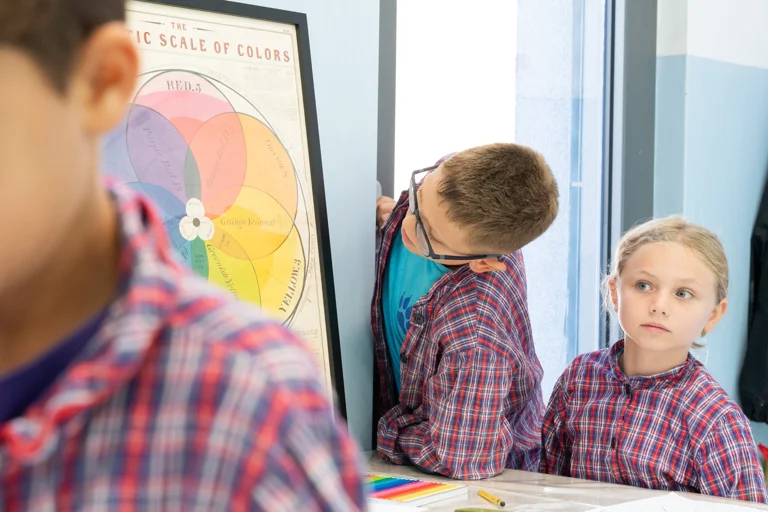
Growing up in a bilingual school means using two languages every day, quite naturally. You don’t study a foreign language: you live in two languages. Children and young people use them fluently to communicate, play, solve problems, understand and process information.
Year after year, this daily practice builds solid skills that can be certified internationally.
Becoming Education works in partnership with Bilingualism Matters, an international research centre on bilingualism, so our approach is always grounded in the latest research. .
The benefits of bilingualism
- Stronger logical skills Greater analytical and problem-solving abilities
- Greater attention and concentration Switching between languages requires focus
- Greater creativity A natural tendency for divergent thinking and non-verbal creativity
- Stronger working memory Bilingual children often find it easier to do mental arithmetic and to memorise instructions
- Cultural openness and long-term benefits Recognising the diversity of viewpoints, an open-minded attitude towards the world’s cultures, and greater mental flexibility even in adulthood
The role of teachers
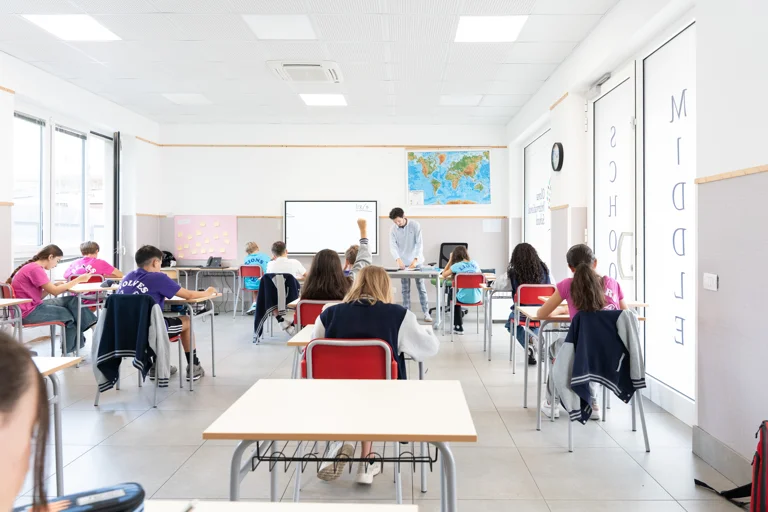
The team consists of native Italian and English-speaking teachers, supported by a specialist German teacher from Year 3 of primary school.
Our teachers take turns in the classroom, following a language programme shaped by the latest thinking in international education.
Our native English-speaking teachers come from a variety of countries and bring with them international teaching experience, that gives pupils authentic exposure to English in real, everyday contexts, with natural pronunciation and plenty of variety.
They work alongside fully qualified Italian teachers with specialist training in bilingual education, who have a thorough understanding of how the bilingual mind works and how children learn languages..
Everyone works together to design each educational programme, creating a bilingual environment that is warm, welcoming and consistent, where language becomes an opportunity for connection and growth.
The importance of one’s mother tongue
The mother tongue is the foundation upon which all other language skills are built. Italian remains a stable and emotionally significant point of reference, whilst English is introduced as a tool for exploration, play and research, and as a vehicle for subject-specific content.
The transition between the two languages is gradual and supported by trained teachers. There is no competition between the languages: they reinforce one another. In fact, there is an interesting aspect to this: Italian, with its clear rules (it is read as it is written), acts as a springboard for learning English, which, by contrast, has more complex rules governing spelling and pronunciation.
PRIMARY SCHOOL
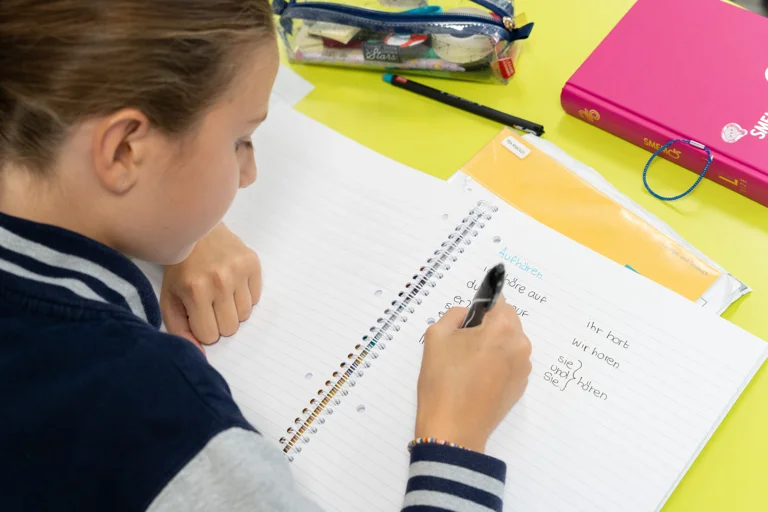
English becomes a tool for learning: reading, writing, collaborating and presenting ideas. We adopt an immersive CLIL (Content and Language Integrated Learning) model based on the ‘One Teacher – One Language’ approach.
Subjects and everyday activities are taught in English whenever this helps pupils learn. Each activity is designed to enable children to understand, participate and communicate with increasing independence.
German is also introduced from Year 3 at Primary School, initially in a natural way through shared activities.
Overall:
- Communicative approach: listening, speaking, reading and writing
- CLIL in science, art, music, geography and technology
- Cambridge Young Learners Language Certifications
MIDDLE SCHOOL
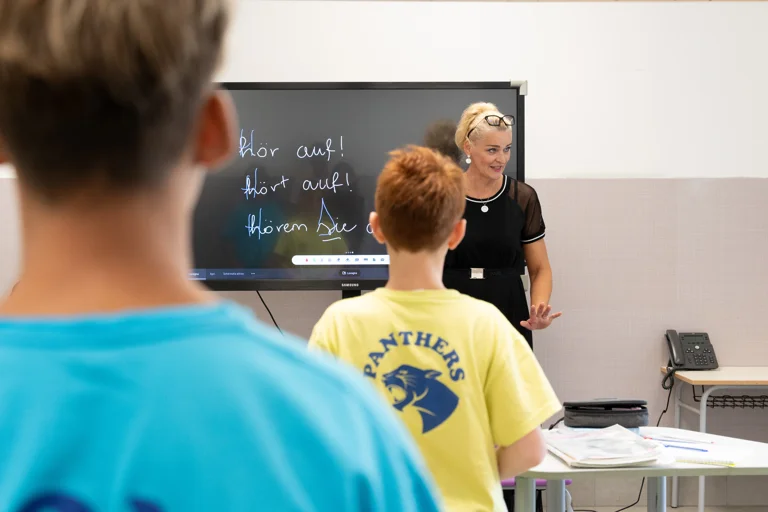
Multilingualism becomes an advanced, certified skill: students work on complex texts, oral presentations, research projects and building their academic vocabulary.
The OIS Middle School is a genuinely multilingual environment. Pupils study subjects in Italian, English and German, following a programme that leads to internationally recognised qualifications.
- More structured and interdisciplinary CLIL activities
- Comprehension and production of complex texts
- Presentations, debates and research papers
- Cambridge B1 and B2 Certificates
- Goethe-Institut Fit A1 Certificates
Cambridge Certifications
Primary and Middle School pupils also follow a carefully structured Cambridge English programme leading to internationally recognised qualifications.
At OIS, the Cambridge programme begins in Year 2 and continues through the end of Middle School:
- Pre A1 Starters
- Movers A1 – End of Year 4
- Flyers /A2 Key For Schools – Year 5
- B1 Preliminary For Schools – End of Year 2 of secondary school
- B2 First for Schools – End of Year 3 of secondary school
Goethe Institut Certifications
German is taught from Primary through to the end of Middle School, where pupils have the opportunity to achieve Goethe-Institut qualifications recognised across Europe and internationally.
With three hours of German each week throughout Middle School, pupils develop all four language skills while preparing to sit the following official Goethe-Institut qualification:
- Goethe-Zertifikat Fit in Deutsch 1 (A1)
Frequently asked questions
Children and young people grow up in an environment where Italian and English coexist naturally, using both languages as tools to communicate, think, and understand the world.
This means that languages are not just subjects to be studied, but become the natural vehicle for exploring disciplines such as science, art, music, geography, and technology.
Our native English-speaking teachers come from various countries, ensuring authentic exposure, natural pronunciation, and a wealth of linguistic models.
Start your journey at OIS
Come and discover the school: book a visit or request information. We look forward to welcoming you